TL;DR
Anxiety often hits the body before it becomes a story. Nervous-system science, Stoic practice, and yogic breath each offer a way to settle that surge, and they quietly agree on slowing the next breath, noticing without a verdict, and practicing the pause before you need it. You do not have to blend the traditions. Pick the door you can actually reach.
Anxiety hits the body before it turns into a story. Modern nervous-system science, Stoic practice, and yogic breathing each open a different door to that moment. They agree on a few moves: lengthen the next breath, notice what is happening without a verdict, and treat the surge as information rather than an order. You do not have to blend the paths. Use the one you can reach right now.
Why does anxiety show up in the body first?
Anxiety is not only a thought. It changes your breathing, your muscles, your gut, and your attention.

When your system reads a threat, real or remembered, it prepares you to move. The heart speeds up. The breath rises into the chest. The jaw and shoulders lock. That is not a failure of character. It is old equipment doing its job.
The story comes second. You feel the surge, then you name it, then you argue with it. Argue only with the story and the body keeps sending the same signal.
What does nervous-system science actually say about calming down?


Photograph courtesy of United States War Department, Public domain
Your autonomic nervous system runs two modes that matter here. One readies you for action. The other supports rest, digestion, and ordinary contact with the room.
You cannot lecture the mobilizing mode into silence. You can give it evidence of relative safety. Slow breathing, especially a longer exhale, is one of the most direct signals you have. Feeling your feet on the floor works too. Looking around and naming what you see tells the system the threat is not this moment.
This is physiology, not a personality upgrade. A calmer body allows clearer thinking. Clearer thinking helps you stay with the body. The loop runs both ways.
Science does not ask you to join a tradition. It asks you to notice that breath, muscle, and attention already talk to each other.
How did the Stoics work with a racing mind and a tight chest?
The Stoics did not treat the first jolt in the body as moral failure. They saw that an impression can strike before you choose anything.

What they trained was the next move. You do not have to accept the first story the jolt offers. In the Enchiridion, Epictetus taught that people are disturbed not by events, but by the judgments they form about events. Between the tight chest and the conclusion "I cannot bear this," there is a gap. That gap is the work.
Marcus Aurelius, in Meditations 4.3, described an inner retreat that does not require leaving the room. You return to what is actually in front of you and what is actually yours to do. The distinction between what is up to you and what is not is not a slogan. It is a way to stop wasting energy on what will not yield.
Stoic practice is mostly attention and judgment. It still lands in the body, because a withheld verdict lets the surge finish instead of feeding it. You are not asked to become cold. You are asked to wait before you add fuel.
The Stoics did not hand down a breathing method like the yogic traditions. If a slow breath helps you hold the pause they describe, that is your body helping a philosophical practice. It does not mean they taught yogic breath.
What does yogic breath teach that talking cannot?
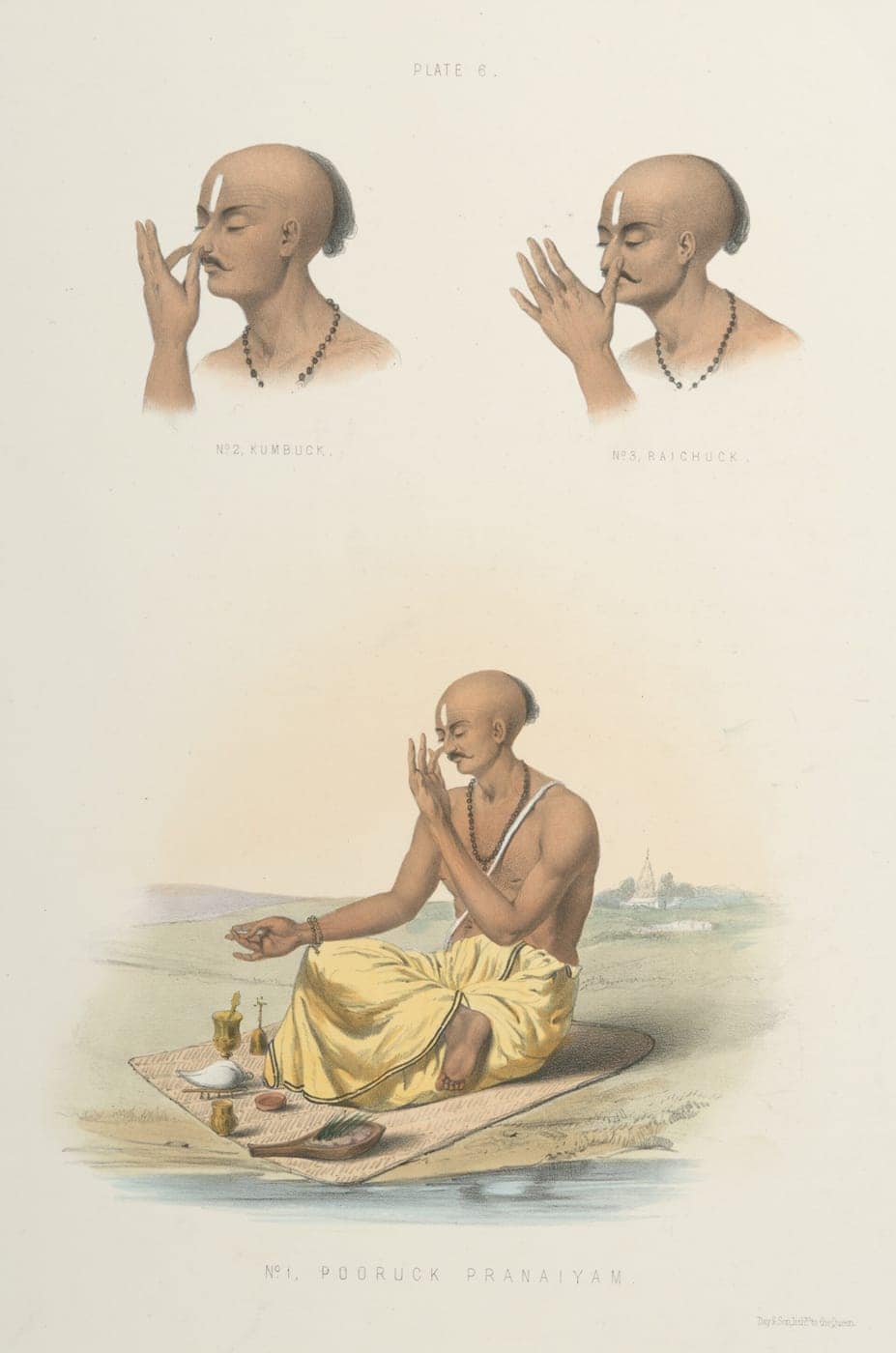
Yogic practice treats the breath as a bridge. When the breath is ragged, the mind tends to follow. When the breath is steady, the mind has a rhythm it can join.
Photograph courtesy of Sophie Charlotte Belnos / New York Public Library, Public domain
You do not need a complex technique to begin. Sit or stand with a long spine. Breathe through the nose if you can. Let the exhale last a little longer than the inhale. Stay with the feeling of air at the nostrils or the movement of the belly.
In this view, the point is not to crush feeling. It is to meet the life in you without chasing it or shoving it away. Presence matters more than performance.
If a practice makes you dizzy, strained, or more frightened, stop. Breath work is powerful because it is intimate. Respect that. You are not failing a tradition by keeping it simple and kind.
Yogic breath does not require you to accept a scientific model, and science does not need to certify yoga. Let each speak in its own voice.
Where do these three paths quietly agree?
They agree that the body is part of the conversation, not a problem to think your way past.

Photograph courtesy of Thamizhpparithi Maari, CC BY-SA 3.0
They agree that a pause matters. Science describes it as a shift in autonomic state. Stoicism describes it as withholding assent. Yogic practice describes it as staying with the breath instead of the spiral. The maps differ. The human moment is similar.
They agree that attention can be trained when you are not in crisis, so it is available when you are.
They agree that you start from where you are. A clenched jaw is information. A short breath is information. Shame about either only adds weight.
They do not agree on metaphysics, and you do not need them to. Shared human needs do not require a merger of worldviews.
What can you do in the next anxious minute?
Feel one contact point: feet, seat, or back against the chair.

Photograph courtesy of Felipe Gabaldón, CC BY 2.0
Lengthen the exhale for a few cycles. No drama. No count you cannot keep.
Name three things you can see, without interpreting them.
Ask one Stoic question if it helps: what here is mine to do, and what is not?
Then take the next ordinary action. Pour the water. Send the message. Step outside. Calm is often a slightly better next move, not a new personality.
If anxiety is severe, persistent, or tied to trauma, work with a qualified clinician. These practices can sit beside care. They do not replace it.
How do you honor each path without mixing them into one?

Use one door at a time. If you are breathing, breathe. If you are examining a judgment, examine it. You can respect a scientific explanation in the morning and a Stoic line at night without forcing them to shake hands.
Do not claim that yoga secretly discovered modern autonomic science, or that Marcus Aurelius was practicing yogic breath. That kind of blending sounds generous and erases both.
What you share with every other person is simpler than doctrine. You want a nervous system that can settle. You want a mind that can pause. You want a sense that you belong in your own body. Those needs are old. The methods you choose can stay distinct.
If this resonates, you can find the numbers behind your own patterns or sit with one of our guided meditations.
Sources
Numerologist and Master Teacher
Brian Wroblewski is the founder of The Healer's Code. He reads charts with the Pythagorean system and teaches people how to understand the numbers they were born with.