TL;DR
Fear multiplies futures and demands a guarantee. Intuition is usually shorter, specific, and willing to be checked. You tell them apart by what they ask you to do next, not by how intense they feel.
Both of them show up in the body. The stomach drops. The mind offers a picture. You want a rule that says which one is holy and which one is a glitch. There is no costume that settles it. There is a difference in what each one asks you to do next.
A clinical dictionary draws a line that is useful here, and it is not a claim about intuition. The APA Dictionary of Psychology describes anxiety as a future-oriented response to a diffuse threat: the body braces for a catastrophe that has not arrived. Fear, in the same dictionary, is the short alarm at a present, identifiable threat. This blog post uses "fear" the way people use it in the kitchen, which often means that future-facing brace. Intuition, as the word is used here, is the shorter knowing you can check. The dictionary does not certify that knowing. It only keeps two alarms from being one word.
You do not need certainty to walk. You do need a way to avoid handing the afternoon to a false alarm, and a way to avoid talking yourself out of a clean knowing.
What does fear do that intuition does not?
Fear multiplies. One door becomes ten disasters. It wants a guarantee, a full script, and someone else to blame if the script fails. It speaks in forever: always, never, ruined, too late.
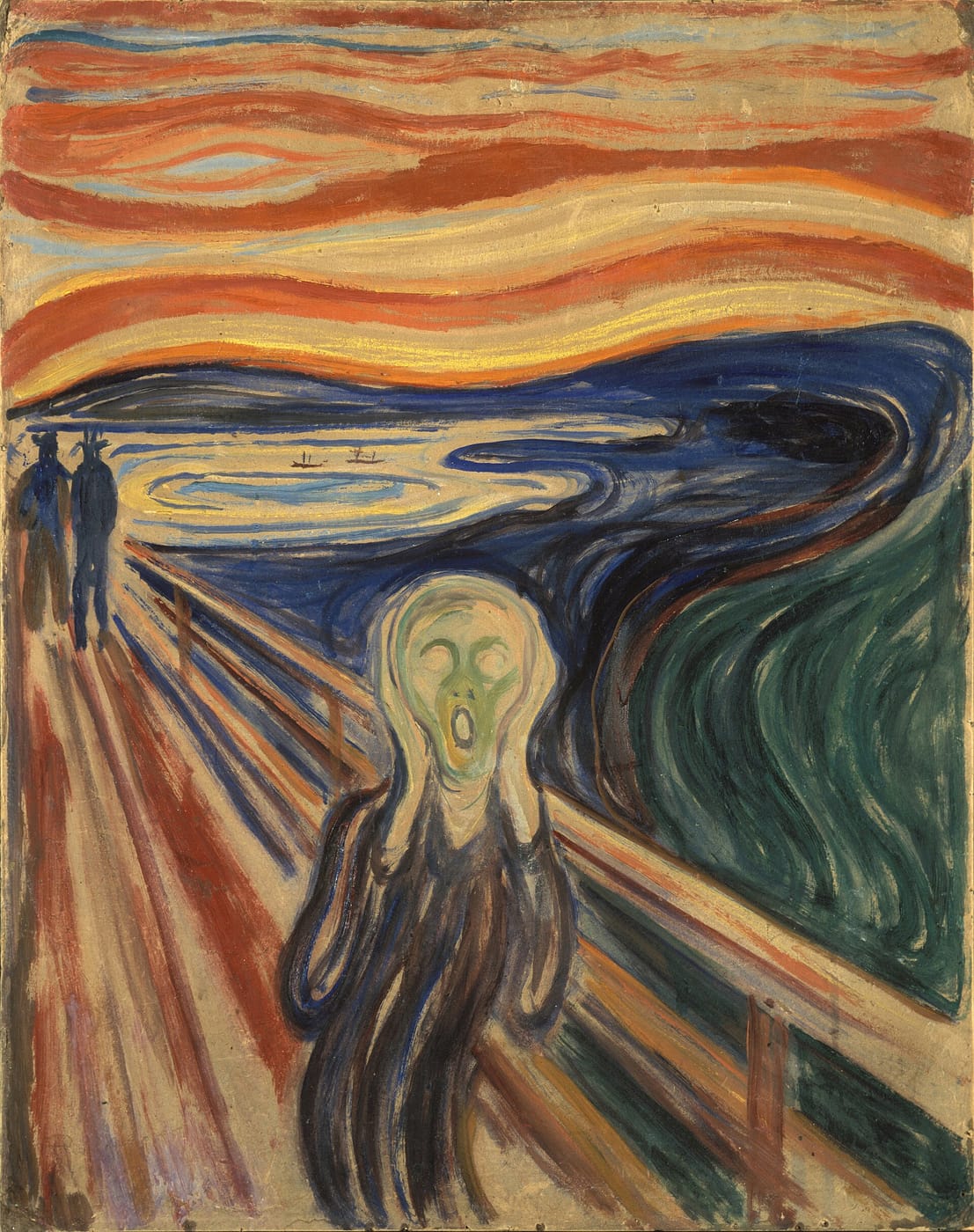
Photograph courtesy of Edvard Munch, Public domain
That pattern matches the dictionary's future-facing alarm more than it matches a present threat you could point at. If you cannot name the threat in the room, you are probably in the long brace, not in a clean stop.
It is also loyal. It learned somewhere that speed and suspicion kept you intact. Thank it for the history, and do not give it the microphone for every decision.
What does intuition feel like when it is quiet?
Intuition is usually shorter. One sentence. One no. One name. It does not build a courtroom. It is often willing to be wrong, which fear almost never is.
Photograph courtesy of Gabriel Fredrick Sindahnai, CC BY 4.0
It can be physical without being frantic. A clear stop. A clear go. If the message needs a long defense before you have even moved, you are probably in the argument, not in the knowing.
When the signal is tangled with a part of you that does not want to be seen, sort that first. Shadow work is the sort. A buried shame will imitate intuition so it can stay in charge.
A practical tell: intuition survives a smaller version of itself. "Call them" can become "send one honest sentence." Fear does not like the smaller version. It wants the whole future settled before the first step. If the signal gets clearer when you shrink it, treat that as information. If it gets louder and vaguer, you are still in the brace.
How do you test it without a performance?
Write the message in one line, before you explain it. Ask what the next hour would look like if you treated it as information, not as fate. Take the smallest action that would confirm or correct it.

Photograph courtesy of Joanna Kosinska, CC0
If this is about another person, keep the line to yourself until you can say it as a question. The senses coming awake do not give you a license to narrate someone else's interior.
The picture of getting lost and still finding the exit is the labyrinth. You are allowed to walk a wrong turn and revise. That is not a failure of intuition. That is how you learn its voice.
The test is ordinary. You do not need a witness, a ritual, or a score. You need a line you wrote down, a small move, and a later look at what actually happened. If you skip the later look, you will remember the hits and forget the misses, and the voice will get harder to trust for no good reason.
What do you do with the next hour?
Pick the decision that is actually in front of you, not the one five years out. If the body is screaming about a future it cannot see, you are in fear's workshop. If you have one clean instruction you could follow and then check, follow that, and check it.

Photograph courtesy of Dietmar Rabich, CC BY-SA 4.0
You will confuse them again. The practice is the second look, not a perfect first one.
None of this is a diagnosis, and it is not a reason to ignore a real danger in the room. If the threat is present and specific, that alarm is doing its job. Listen to it. The sorting in this blog post is for the alarm that has no object you can name.
Numerologist and Master Teacher
Brian Wroblewski is the founder of The Healer's Code. He reads charts with the Pythagorean system and teaches people how to understand the numbers they were born with.