TL;DR
Terminal lucidity is the documented return of clear thinking and personality shortly before death in people who seemed cognitively gone. Science can describe it but not fully explain it, and that gap is honest rather than mystical. For reflective work, it points to a simple idea: your sense of self may be more layered than any single measure, including a numerology chart, can show.
Terminal lucidity is the return of clear thought, memory, and personality in a dying person who had seemed cognitively lost, often in the days or hours before death. Doctors have documented it in case reports for years, but nobody fully understands why it happens. What it teaches, quietly, is that the self you show on a chart or a scan may be far more layered than any single measurement suggests.
If you have sat with someone through dementia or a long final illness, you may already know the moment I mean. The person who had not spoken clearly in months suddenly says your name, asks about a grandchild, laughs at an old joke. Then they are gone. It is one of the most tender and confusing experiences a family can have.
What is terminal lucidity, exactly?
It is a brief, unexpected return of mental clarity near the end of life. A person with advanced dementia, a brain tumor, or another condition that had erased their usual awareness becomes lucid again.

Photograph courtesy of Wellcome Collection / Henry Clarke, CC BY 4.0
They recognize loved ones, hold a real conversation, and act like themselves.
Researcher Michael Nahm helped bring the modern term into clinical discussion, and the phenomenon has been the subject of scholarly review since. The U.S. National Institute on Aging has taken an interest in what's sometimes called paradoxical lucidity in dementia and has backed discussion of it as a research question. That matters, because it means the observation is being taken seriously instead of waved off as anecdote, even though it's still an open, unsettled area of study rather than a solved puzzle.
The episodes are usually short. Some last minutes, some a day or more. They do not signal recovery. Often they arrive close to the end.
Why can't current models fully explain it?
Because the tissue-level story doesn't obviously allow for it. In advanced dementia, the physical structures we associate with memory and personality are often badly damaged. The standard model says clear cognition needs those structures working. So a sudden return of the person is genuinely hard to account for.
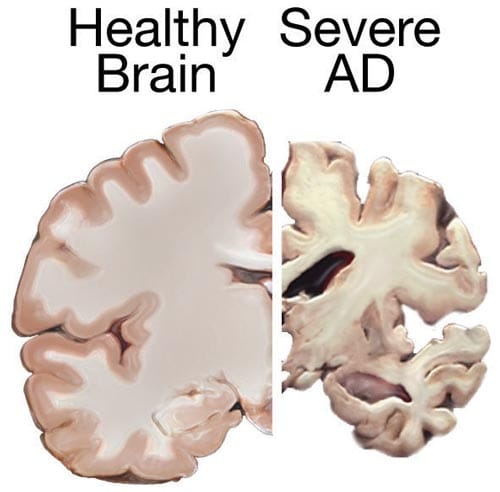
Photograph courtesy of National Institutes of Health, Public domain
Researchers have floated some possibilities: shifts in brain chemistry near death, changes in blood flow or oxygen, or networks compensating in ways we haven't mapped well yet. These are proposed directions in the literature, not settled answers.
The honest position is that we can describe terminal lucidity better than we can explain it. That's not a failure. It's what an open scientific question looks like before the answer shows up. If you're curious about the wider territory here, What Science Actually Understands About Consciousness covers related open questions, and What Happens to the Soul After Death, According to World Traditions explores how different cultures have made sense of this threshold.
What does this have to do with self-reflection or numerology?
It offers a useful frame: the self is not a single readout. Terminal lucidity suggests that "the person" can be present even when the measurable substrate looks like it shouldn't allow for it. Whatever you believe about why, the lesson for daily reflection is humility about any one lens.
Photograph courtesy of Bibliothèque nationale de France, Public domain
A numerology chart is a lens, not a scan of your soul. In the method we treat numbers as a mirror for self-reflection, using the Pythagorean system, as a way to name patterns you already sense in yourself. Your Life Path or an expression of a Master Number like 11, 22, 33, or 44 can help you put language to a tendency. It cannot capture the whole of you, is not a prediction of your future, and was never meant to be either.
Terminal lucidity is a reminder to hold that lightly. If a damaged brain can still let the person shine through at the end, then no chart, no diagnosis, and no label gets the last word on who you are.
How should you sit with a lucid episode if you witness one?
Be present, not analytical. If someone you love becomes clear near the end, the moment is theirs and yours. It's not a puzzle to solve in real time.

Photograph courtesy of Carol M. Highsmith, Public domain
A few grounded ways to meet it:
- Listen more than you speak. Let them lead the conversation.
- Say what you have wanted to say. Simple gratitude and love land well.
- Do not treat it as proof of recovery. Hope is human, but the episode is usually not a turning point toward health.
- Afterward, let yourself feel the mix of gift and grief. Both are appropriate.
If you want to reflect later, that's where a tool like numerology can gently help, not to explain the medical event, but to process what the moment stirred in you about presence, identity, and what you value. You might also find Guided meditations useful for sitting with the grief afterward. This kind of reflection is not a substitute for grief support or medical or psychological care.
What terminal lucidity does not mean
It does not prove any specific spiritual claim, and it does not disprove one either. People of many beliefs find meaning in it, and that meaning is personal. Reporting the observation faithfully is different from selling an interpretation of it.

Photograph courtesy of Bicanski, CC0
It also isn't medical guidance. If you are caring for someone who is seriously ill, your care team is the right source for what to expect. This article is here for reflection and understanding, nothing more, and numerology itself should never be treated as medical, financial, legal, or psychological advice, or as a guarantee of what the future holds.
What terminal lucidity offers, in the end, is a gentle correction to overconfidence. You are more than your worst season, more than a label, more than a single number. If you want a deeper personal mirror for this kind of reflection, you can always Get your Soul Blueprint. Hold your tools, including this one, with an open hand.
Sources
Numerologist and Master Teacher
Brian Wroblewski is the founder of The Healer's Code. He reads charts with the Pythagorean system and teaches people how to understand the numbers they were born with.