
TL;DR
Your consciousness does not travel during dreamless sleep or general anesthesia. The body stays where it is, while the coordinated brain state that supports a reportable experience loosens or drops out. This week you can practice a milder version of that edge by resting awake, without disappearing into a nap.
Your consciousness does not go anywhere when you sleep or when you go under anesthesia. In dreamless sleep and under general anesthesia, the coordinated activity that lets you have a single, reportable experience loosens. The living body stays put while the capacity to hold a scene, a sense of time, and a stable point of view fades.
You stay where you are. Attention dims, or the pieces of experience stop binding together, and later you wake with a gap.
People ask this as if the self were a passenger who has to travel. Sleep and anesthesia research points the other way. Awareness depends on a living brain in a particular state. When that state changes, experience can thin, fragment, or stop being something you can later describe.
This week you can meet a milder version of that edge while you are safe and awake. Rest on your back, keep a thin thread of attention, and notice what happens when you stop trying to stay busy. The practice is below. You can also sit with the Guided meditations if you want a voice with you.
What does dreamless sleep do to awareness?
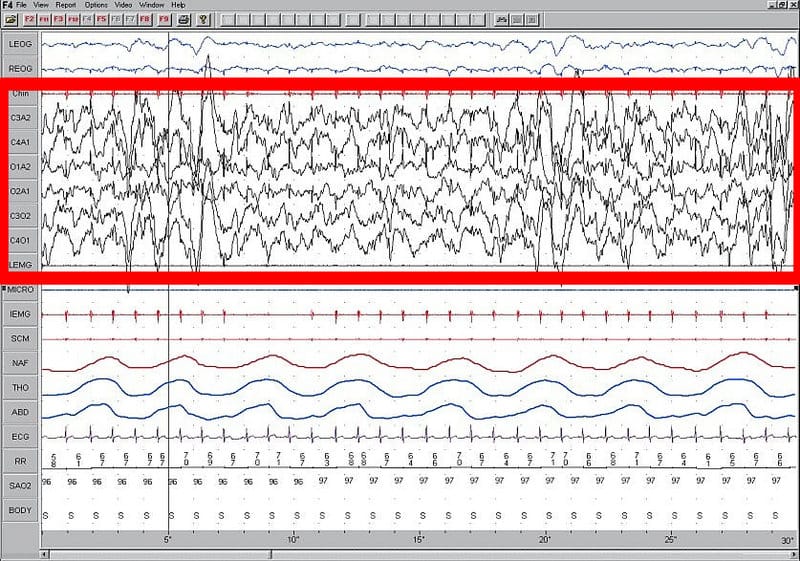
When you are awakened from deep, dreamless sleep, you often have nothing to report. No scene, no thought, no sense that time passed. Researchers use those blank reports to study stretches when consciousness is minimal or gone, even though the brain is still working.
Photograph courtesy of MrSandman, Public domain
You already know the other side of the night. REM sleep and lighter stages can carry vivid dreams. The contrast is the point, because sleep is not a single state. In the deepest slow-wave stretches, the usual story of a continuous inner movie breaks. You can lose the thread of being someone who is having an experience.
Large, slow rhythms in the cortex go along with those blank reports, and so does a drop in the kind of communication that binds distant regions. The brain keeps working while the conditions for a unified, reportable experience fall away.
You do not need a lab to notice a milder version. If you have ever dropped into a nap and come back with no memory of the interval, you have touched the same edge. You woke in the same place, with a gap instead of a journey.
What happens to consciousness under anesthesia?
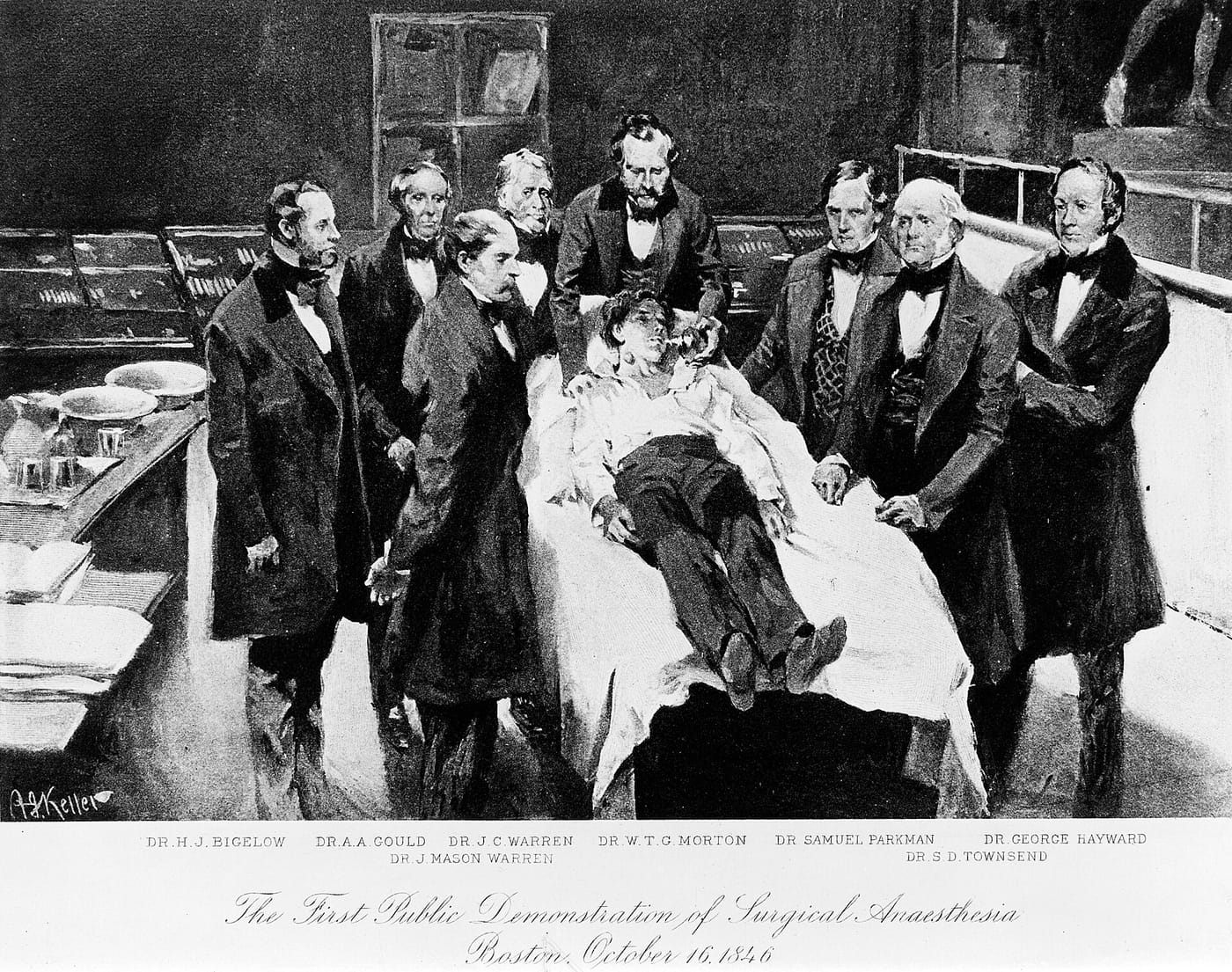
From the outside, general anesthesia can look like sleep. It is a reversible, drug-induced unresponsiveness, so surgery can happen without you suffering it. Different drugs get you there by different routes. What they share is that you stop responding, you form no ordinary memories of the interval, and you typically have nothing to say about where you were.
Photograph courtesy of Wellcome Collection, CC BY 4.0
From the inside, reports after emergence are often like the dreamless reports: a gap. Some people recall fragments, especially with certain agents. The heart keeps beating. Monitors keep tracing activity. What you could later call your own experience drops out.
Researchers study this because it is one of the few times experience can be turned off and on again in a controlled way. The usual long-range conversation in the cortex quiets or fragments. Information that would usually be shared across the brain stays more local. Theories disagree about the exact mechanism and still land on a simpler point: you do not have to leave the body for experience to stop being available.
Anesthesia is serious medicine, and this is only a map of the gap you already know from the recovery room or a blank stretch of night.
If it does not go somewhere, what is happening?
What the work shows is a pattern that can be present, thinned, or gone while you as an organism remain.

In 1995, the philosopher David Chalmers named the puzzle of why any physical process should feel like something at all, calling it the hard problem of consciousness (Chalmers, D. J. (1995). Facing up to the problem of consciousness. Journal of Consciousness Studies, 2(3), 200-219). Sleep and anesthesia leave that puzzle in place, and they still show something you can use. The presence of experience tracks certain states of a living brain. Change the state enough, and the experience you could later report is no longer there.
You can hold both at once: a real mystery about why there is inner life at all, and the plain fact that inner life does not travel. When the pattern that supports it loosens, there is no leftover you watching from the hallway.
Some traditions speak of a witness that never sleeps. Take that as a practice instruction if it helps you stay kind to yourself. Do not force the recovery room to confirm a metaphysics it cannot measure.
How do you rest awake without disappearing into sleep?
This week, give yourself twenty minutes on your back, in daylight or with a lamp on, so the body does not take the cue for night. The aim is rest that does not tip into sleep or into another project.

Lie down. Let the weight of your body be held by the floor. Keep the eyes softly open, or close them and hold a faint sense of the room. Breathe in a normal rhythm. Each time the mind starts a project, return to the simple fact of being here, in this body, in this hour.
If you slide toward sleep, open the eyes and feel the contact of your heels and your back. If you get restless, slow the exhale and stay. Skip the hunt for a vision and learn that rest does not require you to go away.
Do this once in the next seven days. If you want company, use a Guided meditations session and keep the same instruction: rest, stay, do not perform.
Sources
Numerologist and Master Teacher
Brian Wroblewski is the founder of The Healer's Code. He reads charts with the Pythagorean system and teaches people how to understand the numbers they were born with.