
TL;DR
The Golden Rule tells you to treat others as you would want to be treated. Nearly every major tradition arrived at some version of it, which suggests it points at something real about human life. It is less a rule to memorize than a daily practice of imagining your way into another person's position.
What Is the Golden Rule, and Why Did So Many Cultures Discover It?
The Golden Rule says to treat others the way you want to be treated.
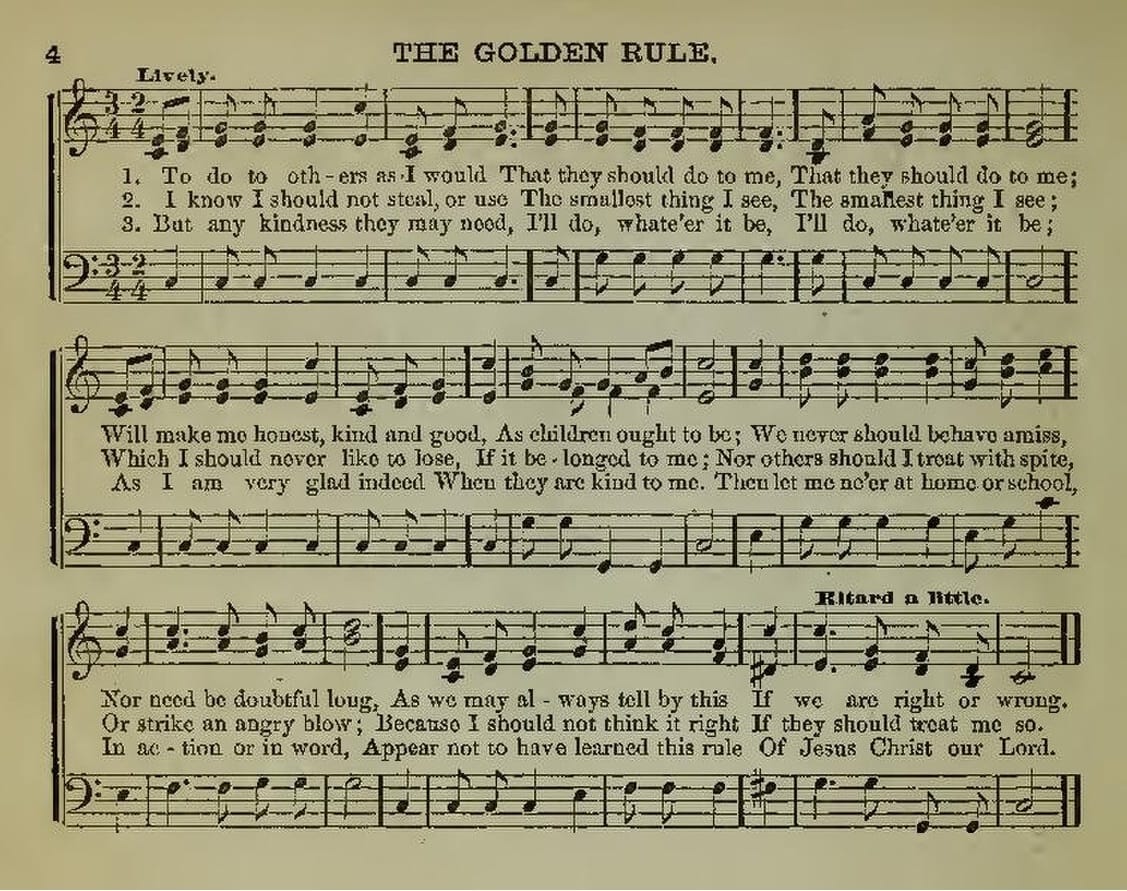
Photograph courtesy of D. M. Bowmar, The Casket of Sunday School Melodies (1865), Public domain
It shows up, in one form or another, in Confucian, Jewish, Christian, Hindu, Buddhist, and Greek thought, among others, which is part of why it's stuck around so long. Read plainly, it's not a soft slogan. It's a demanding practice. It asks you to imagine your way into someone else's position before you act.
You already know the words. The harder, more interesting question is why so many separate cultures landed on the same idea, and what it actually asks of you once you take it seriously.
What exactly does the Golden Rule say?
It comes in two shapes, and the difference matters.
Photograph courtesy of National Palace Museum, Taipei, Public domain
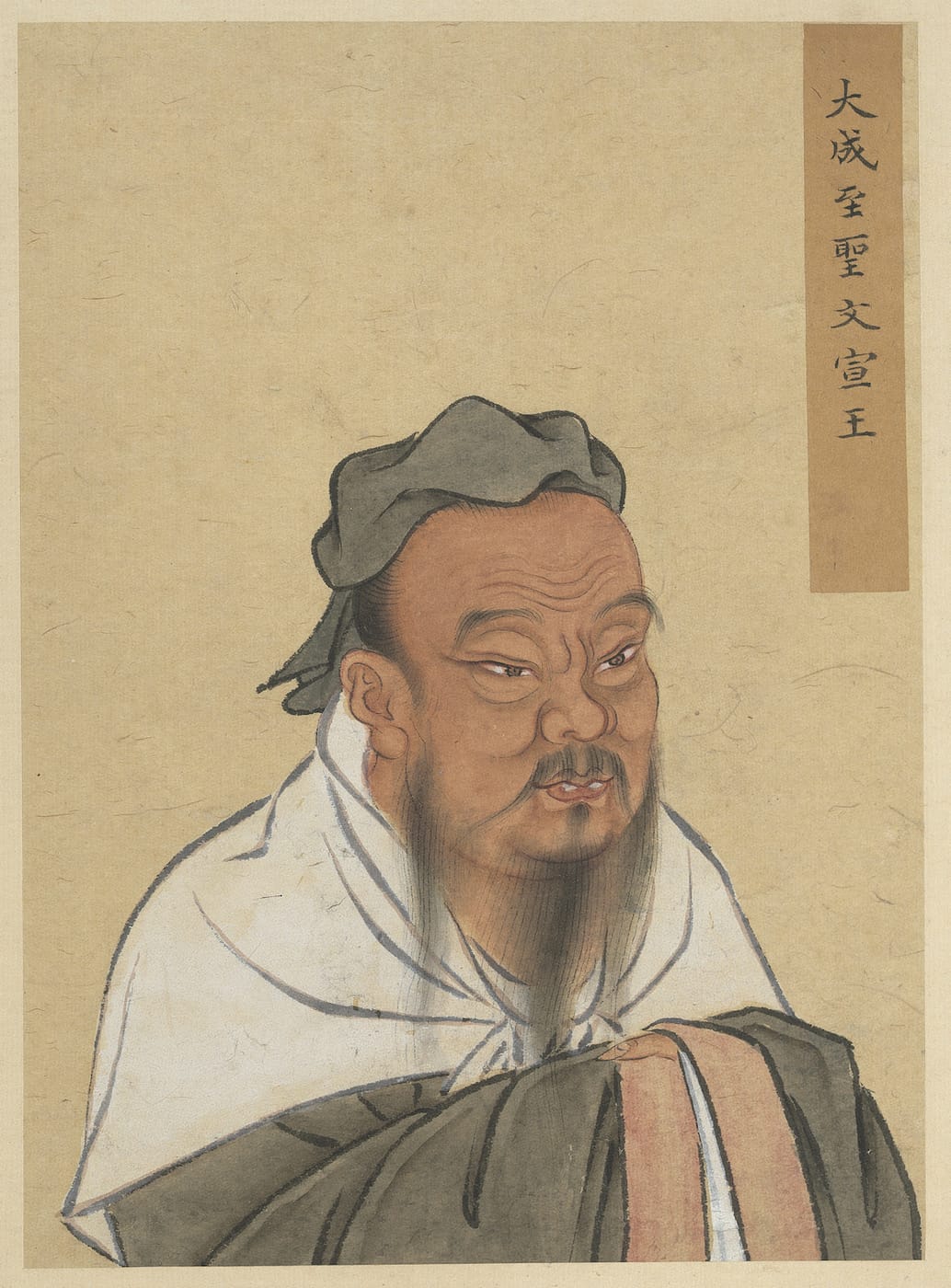
The negative form says: don't do to others what you wouldn't want done to you. People sometimes call this the Silver Rule. Confucius offered a version of it. When a student asked for a single word to guide a whole life, he pointed to reciprocity: don't impose on others what you don't want for yourself (Analects 15.24).
The positive form says: do to others what you would want done to you. This one asks more of you. It doesn't just tell you to avoid harm. It asks you to step forward and offer the care you'd hope to receive.
Both forms rest on the same move. You take your own sense of what feels fair, kind, or bearable, and you extend it outward to someone who isn't you.
Why did so many cultures arrive at the same rule?
Because the problem it solves is universal. Every group of people who has to live together runs into the same friction: your wants collide with mine. Some principle has to govern that collision, or the group falls apart.

Photograph courtesy of Jewish Encyclopedia (1901-1906), Public domain
The Golden Rule is one of the simplest answers that actually works. It doesn't need a shared religion, a shared language, or a shared king. It only needs one thing: that you can imagine being in another person's shoes, which almost everyone can do.
That's likely why it keeps surfacing, phrased differently but pointing the same direction:
- In the Jewish tradition, the sage Hillel summarized the whole law as not doing to your neighbor what is hateful to you.
- In the Christian Gospels, Jesus phrases it positively: do to others as you would have them do to you (Matthew 7:12).
- The Hindu epic the Mahabharata contains a line often rendered as: this is the sum of duty, do not do to others what would cause pain if done to you.
- A Buddhist verse in the Udana-varga expresses the same care not to harm what you yourself would guard against.
You don't need to treat this as proof of anything supernatural. A simpler reading works fine: the rule holds up, so it survived, in many places, independently. This kind of pattern-across-cultures is also part of why the Ancient Idea That Numbers Carry Meaning has endured, different peoples, working independently, kept arriving at similar truths.
What are the common criticisms, and are they fair?
The main objection cuts pretty deep: what you want done to you may not be what someone else wants.
Photograph courtesy of Unknown painter, about 1790, Public domain
Take a simple example. Someone who loves loud parties invites a grieving neighbor to one, reasoning that they'd want the distraction themselves. Apply your own preferences on autopilot and you can miss the mark badly.
That's a fair knock against a lazy reading, and it points to the real skill hiding inside the rule. The deeper version isn't "give people what I would want." It's "give people the consideration I would want," which includes wanting my own preferences respected. Follow that thread and the rule quietly pushes you to find out what the other person actually needs.
Philosophers sometimes describe this as the shift from the letter of the rule to its spirit. The letter is a formula. The spirit is empathy, disciplined and put to work.
How do you actually practice it without turning it into a cliche?
Treat it as a question you ask before you act, not a slogan you nod along to.

Photograph courtesy of FEMA / Casey Deshong, Public domain
Before a hard conversation, a decision that affects someone, or a moment when you feel wronged, try three short prompts:
- If our positions were reversed, what would I hope for right now?
- What am I assuming this person wants, and how would I check?
- What's the smallest kind thing here that I wouldn't regret?
None of these promise a perfect outcome. The Golden Rule isn't a machine that spits out correct answers. It's a habit of attention that keeps other people real to you, right when it would be easier to treat them as obstacles.
That habit is also where reflective practices earn their place. Things like journaling, meditation, or the kind of self-inquiry that The method supports are offered as ways to support self-reflection and insight, not as medical, psychological, financial, or legal guidance, and not as a guarantee of any particular outcome. Used that way, they can help you notice your own patterns: where you extend generosity easily, and where you quietly make exceptions for yourself. The rule only works on people you can actually see, and most of us have to learn to see ourselves honestly first. Our guided meditations are one simple way to build that habit of quiet attention.
Is the Golden Rule enough on its own?
No, and it probably was never meant to be. It's a starting principle, not a full ethics.

Photograph courtesy of DP Singh Bhullar, CC BY-SA 4.0
It points you toward mutual consideration, but it doesn't settle every hard case. On its own, it can't resolve a conflict where two people's reasonable wishes genuinely clash. That takes judgment, context, and usually conversation.
What the rule does well is keep you oriented. When you're tempted to cut a corner, dismiss a person, or convince yourself this one case is special, it pulls you back to a plain test you can't easily wriggle out of: would you accept this if you were on the other side?
Kept that simple, and taken that seriously, it remains one of the most portable pieces of wisdom any tradition has produced. If you want a clearer sense of your own patterns and blind spots as you practice this, you can get your Soul Blueprint, or bring the questions to the community of others working through the same ideas. Carry it into any room, in any century, and it still asks something real of you.
Sources
Numerologist and Master Teacher
Brian Wroblewski is the founder of The Healer's Code. He reads charts with the Pythagorean system and teaches people how to understand the numbers they were born with.