TL;DR
The demiurge is the craftsman who shapes the physical world from existing material, not a creator from nothing. Plato treats that maker as good; some Gnostic teachers treat him as ignorant or hostile. The idea still matters as a question about whether the world is a worthy work or a trap, not as a prediction.
The demiurge is a world-craftsman. He shapes the physical cosmos from material that already exists, not from nothing. Plato sees this artisan as mostly good, copying eternal patterns as well as matter allows. In some Gnostic writings the figure turns into a lesser or hostile power. The idea still forces the question: is the world a worthy work or a trap?
What does the word demiurge actually mean?
Demiurge comes from the Greek dēmiourgos, a public craftsman or artisan who works for the community. Plato used it in the Timaeus for the intelligence that orders the visible world.

Do not picture a distant sky-god. Picture a skilled worker standing over raw material, looking at a perfect model, and making the best copy the stuff will take.
That image carries the whole point. A craftsman is limited by the wood, the clay, the stone.
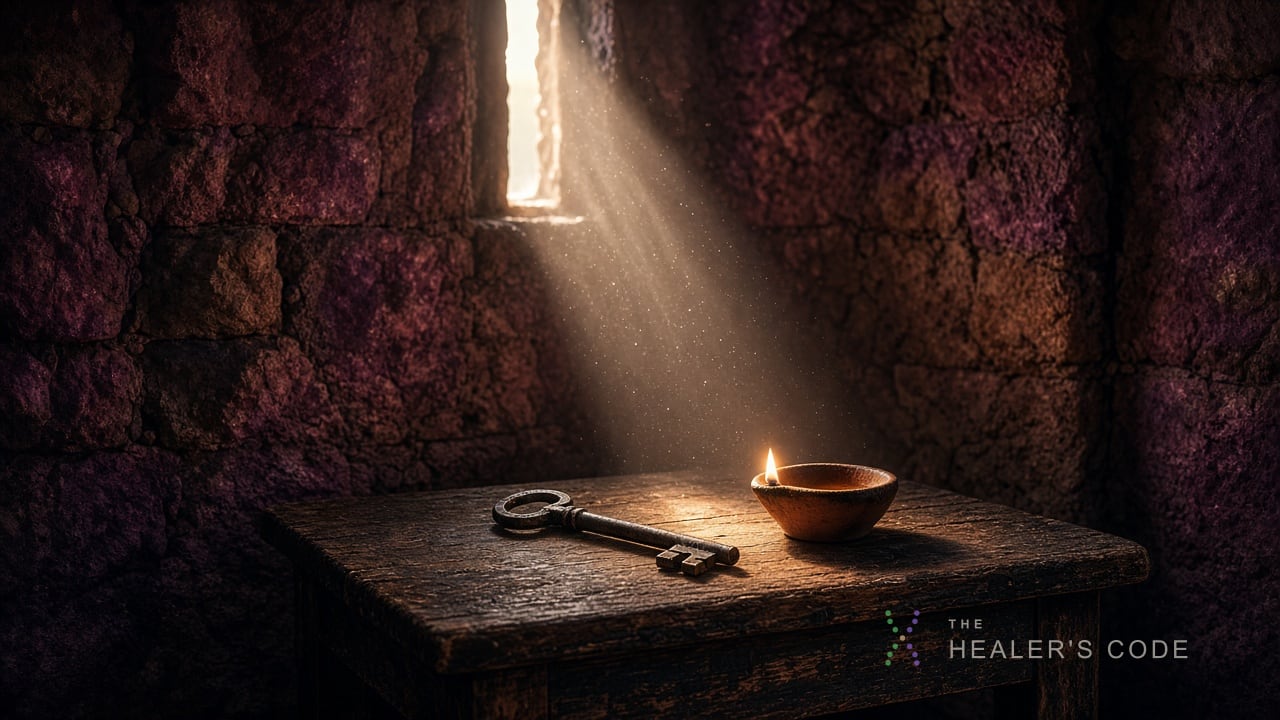
The demiurge shows order meeting resistance.
How did Plato describe the world-maker?
In the Timaeus, the demiurge wants the cosmos to be as good as possible. The craftsman looks to the eternal Forms, the unchanging patterns of what is real, and imposes measure on a restless material sometimes called the receptacle.
The result is a living world, ordered and beautiful, yet bounded by necessity. Plato does not treat this maker as unlimited in the later theological sense. The craftsman is good. The world is good to the degree that chaotic stuff can receive form.
Time, in this picture, is not a prison. It is a moving likeness of eternity. Your days are not a mistake. They are the only way a changing world can imitate what does not change.
Want this read on your own numbers?
Your Blueprint turns these ideas into a personal map, calculated from your name and birth date.
Why did some Gnostic teachers recast the demiurge as a problem?
Some Gnostic teachers kept the craftsman and reversed the moral. For them, the true source of spirit lies beyond the visible cosmos. The demiurge becomes a lesser being who fashions matter without knowing that higher source, and who sometimes claims to be the only god.
In the Nag Hammadi text known as the Apocryphon of John, this figure is called Yaldabaoth and is tied to ignorance and to the binding of spirit in flesh. You do not have to take that cosmology as a report of events. Notice the move itself. The world-maker is no longer a wise artisan. He is the reason you feel stuck.
The philosopher Plotinus, writing in the Enneads, rejected that contempt for the world. He argued that to despise the cosmos and its maker is to miss the goodness already present in ordered things. So the argument is old, and it is not settled. One tradition says honor the work. Another says do not confuse the workshop with home.
What is the demiurge actually asking you?
This is not a prediction of your future, and it is not medical, financial, or psychological advice. It is a perennial question about the status of the world you wake up in.
Is physical life a worthy copy of something higher, a flawed but honest attempt, or a cage? Your working answer will color how you treat your body, your labor, and the ordinary room you are sitting in.
If the craftsman is good, then giving form to matter is a kind of reverence. Cooking, building, healing, and keeping a promise become ways of participating in order.
If the craftsman is ignorant, then your task is remembrance. Do not take the given world as the last word, and do not confuse the manager of appearances with the true good.
You can hold both insights without joining a school. The world can be beautiful and still not be enough. That tension is the wisdom in the myth.
If you already use The method as a mirror for self-reflection rather than as a verdict, treat the demiurge the same way. It is a symbol for intelligence meeting resistance, not a being you must believe in to live well.
How is this different from a creator God?
Later Jewish and Christian theology often speaks of creation from nothing. Plato's demiurge does not make the raw material. He orders what is already there.
That difference is easy to blur and costly to blur. A craftsman is limited by the medium. A creator from nothing is not. When you mix the two pictures, arguments about evil, the body, and responsibility slide past one another.
You do not have to pick a camp tonight. You only have to notice which picture you have been living by. Do you treat the world as a well-made work that asks for your care, or as a false surface you must see through? Both have truth in them. Neither is a forecast. Both are a practice.
Brian Wroblewski
Numerologist and Master Teacher
Brian Wroblewski is the founder of The Healer's Code. He reads charts with the Pythagorean system and teaches people how to understand the numbers they were born with.