TL;DR
Physics treats dark matter as unexplained mass in gravity, not as a theory of mind. Consciousness is the fact of experience, still unexplained at its root, and closely tied to a living brain. You can honor both unknowns without turning them into one story, and you can practice that distinction this week.
Physics does not identify dark matter with consciousness. Dark matter is a working name for mass that shows up in gravity and does not show up in light, and consciousness is the fact that experience is happening for you. You can hold both mysteries without fusing them into one explanation.
What does physics mean by dark matter?
Physicists use "dark matter" when the gravity of a galaxy, a cluster, or the early universe cannot be accounted for by the matter that emits or blocks light.
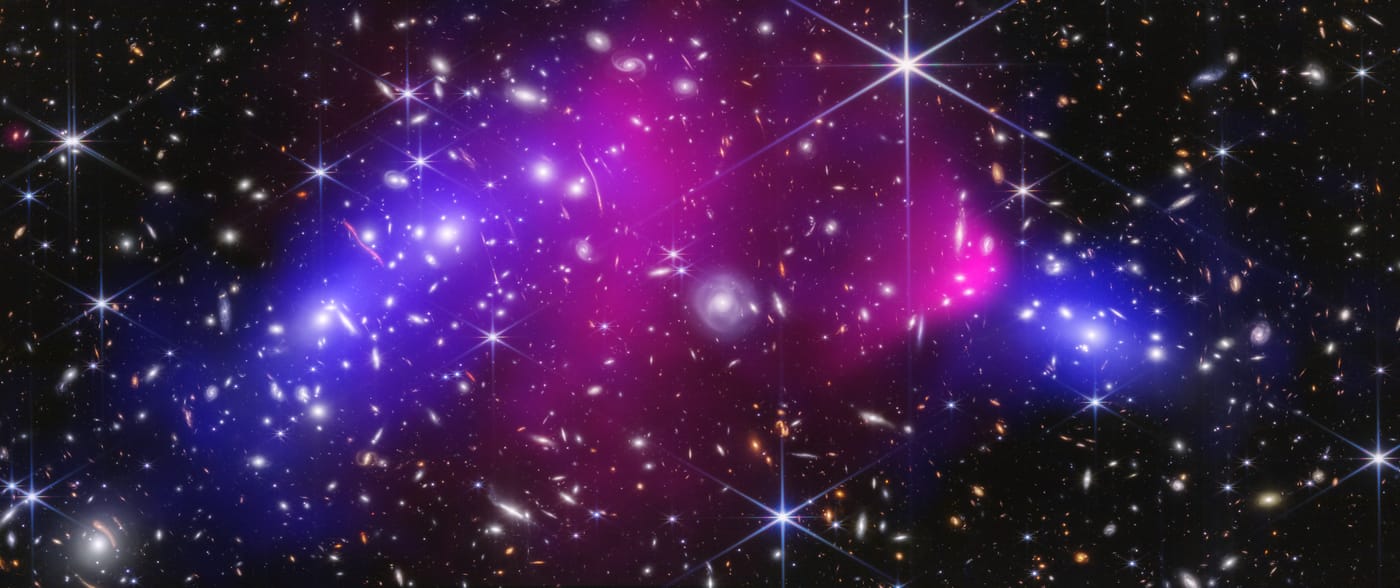
Photograph courtesy of NASA, ESA, CSA, STScI, CXC, Creative Commons
The phrase names a discrepancy, not a substance you can point to on a shelf.
You do not need the equations to get the shape of the claim. Stars in the outer parts of many galaxies move as if more mass is present than the shining matter can provide. Light from distant objects bends as if extra mass sits along the path. The large-scale pattern of the cosmos is easier to model if most of the mass does not shine.
None of that tells you what the extra mass is. It could be a particle that barely interacts with light. It could be something else. As of now, there is no confirmed detection of a dark matter particle. That open question is part of the science.
Gravity is treated as real while the identity of the mass stays unknown, which is the honest core of the term.
Does any of that describe your awareness?
Consciousness, as you live it, is the presence of experience: the blue of a sky, the sting of a memory, the simple sense that you are here.

Photograph courtesy of Jeffrey Betts, Creative Commons
Neuroscience can track correlates. Attention has signatures in the brain. Damage certain tissue and what you can report of experience changes. That work still leaves the hard problem standing: why those processes should feel like anything from the inside.
Dark matter, as physics uses the term, does not participate in electromagnetism in any ordinary way. Your brain does. Neurons, synapses, blood, and the instruments that read them all live in the world of light, charge, and chemistry. A theory that puts your inner life inside a substance defined by not interacting with that world has a steep hill to climb, and evidence has not taken it there.
You can love mystery without relocating your mind into the unmeasured mass of galaxies.
Want this read on your own numbers?
Your Blueprint turns these ideas into a personal map, calculated from your name and birth date.
Where does the speculation start?
Speculation starts the moment two gaps are treated as one answer. Dark matter is unknown, and consciousness is unexplained at its root. Unknown plus unknown can feel like a match, and that feeling is not a measurement.

You will meet the idea in videos, books, and late-night conversations: maybe mind is the missing mass, maybe awareness is a field the cosmos is made of, maybe you are swimming in dark matter every second. That can live in poetry without becoming a physical claim.
The temptation is human. A complete story soothes. You already know how it feels when a reading, a theory, or a teacher offers to close a hole you have lived with for years. Stay kind to that wish, and stay strict with what would count as support.
If a claim cannot say what would change in a detector, a telescope, or a clinical measure if it were true, you have left physics for meaning-making, which has a place in a life and cannot stand in for evidence.
How do you read a claim that mixes the two?
Start with the verb. Does the writer say "might," "could," or "is"? "Might" can be a hypothesis, while "is" needs data.
Ask what happens to the well-mapped dependence of experience on a living brain. A stroke, an anesthetic, a night of true sleep: these change what you can report. Any serious proposal has to live with that, not float above it.
Ask whether the hard problem is being solved or renamed. Calling awareness a cosmic field does not explain why a field would feel like grief or taste like coffee. It moves the question to a larger stage.
You do not owe every fusion of mysteries your belief. You owe your own attention a clean distinction between what has been shown and what would be beautiful if it were true.
What can you practice with this, this week?
This week, practice the line itself. When you meet a sentence that joins dark matter to mind, pause. Say out loud what is known, what is inferred, and what is hoped.

Then give attention a small, honest job. Sit for ten minutes and watch the coming and going of sound, breath, and thought. You are meeting the only consciousness you have direct access to, not proving a cosmology.
If you want a companion for that sitting, use one of the Guided meditations and keep the instruction simple: notice when the mind reaches for a total explanation, and let the reaching be seen.
The work is to stay in contact with what is given, including the size of what you do not know, rather than to become certain.
Sources
Brian Wroblewski
Numerologist and Master Teacher
Brian Wroblewski is the founder of The Healer's Code. He reads charts with the Pythagorean system and teaches people how to understand the numbers they were born with.