TL;DR
Many animals have consciousness in the sense of felt experience, with the strongest case for mammals, birds, and octopuses. Whether they are aware that they are aware is a narrower question, with clues from self-recognition and metacognition in a few species. You cannot prove another mind from the outside, but the evidence is already strong enough to change how you watch and care for the animals near you.
Many animals show the neural and behavioral signs researchers treat as evidence of consciousness. They attend to the world and perceive it. Whether they are aware that they are aware is a different question, and the evidence there is thinner and more mixed.
You cannot climb inside another mind. That limitation applies to your neighbor as much as to a whale. What science can do is map the neural systems associated with experience, watch how animals behave when those systems are engaged, and test whether some of them can treat their own knowledge as an object.
Mammals and birds sit on relatively firm ground. Cephalopods have forced the field to widen. Claims about fish and insects are more contested, which is a reason to stay precise rather than dismiss them.
Use the evidence as a report on minds. Meet other lives with fewer stories and more care.
What counts as consciousness in an animal?
Consciousness here means felt experience: there is something it is like to be that animal, even if it cannot tell you in words.
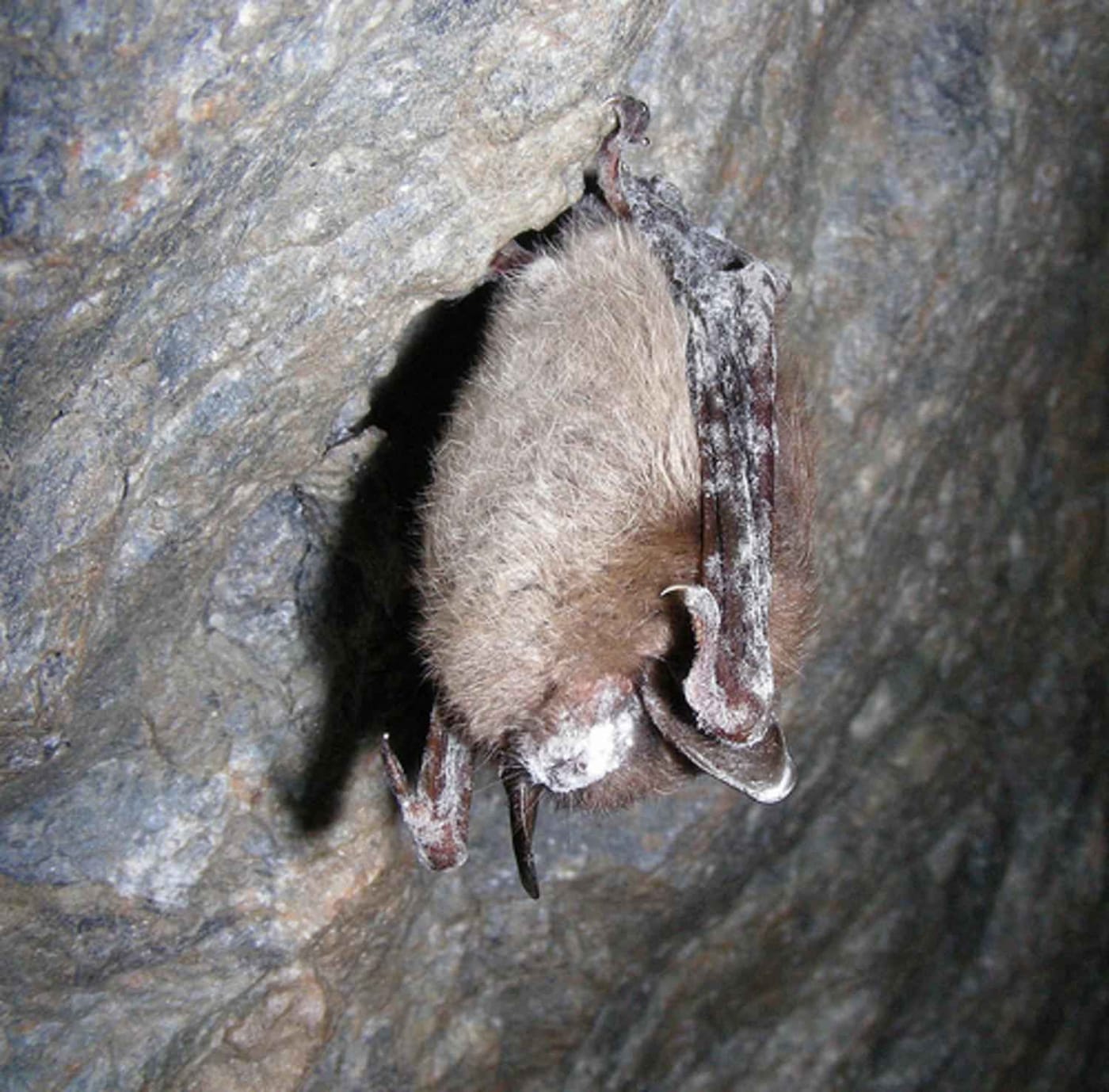
Photograph courtesy of Moriarty Marvin, U.S. Fish and Wildlife Service, Public domain
Thomas Nagel asked, in 1974, what it is like to be a bat, and that question still names the gap between third-person description and first-person experience (Nagel, T. (1974). What is it like to be a bat? The Philosophical Review, 83(4), 435-450). Do not confuse that gap with intelligence, language, or a human-shaped personality.
Start with attention and perception, the layers you can actually watch. When a cat tracks a moth, when a crow hides food, when a dog flinches at a tone it has learned to fear, the nervous system is doing work that, in you, arrives as experience.
That the work is felt, rather than only computed, stays an inference. Nobody watches the feeling from outside.
In 2012, a group of scientists at the Francis Crick Memorial Conference issued the Cambridge Declaration on Consciousness. It stated that humans are not unique in possessing the neurological substrates associated with consciousness, and that non-human animals, including all mammals and birds, and many other creatures including octopuses, also possess those substrates. The declaration named a shift already underway in the labs without ending the debate.
Which animals show the strongest evidence?
Mammals and birds are the clearest cases in the current literature, because their brains support functions associated with seeing, nociception, and staying oriented in a world that matters to them.
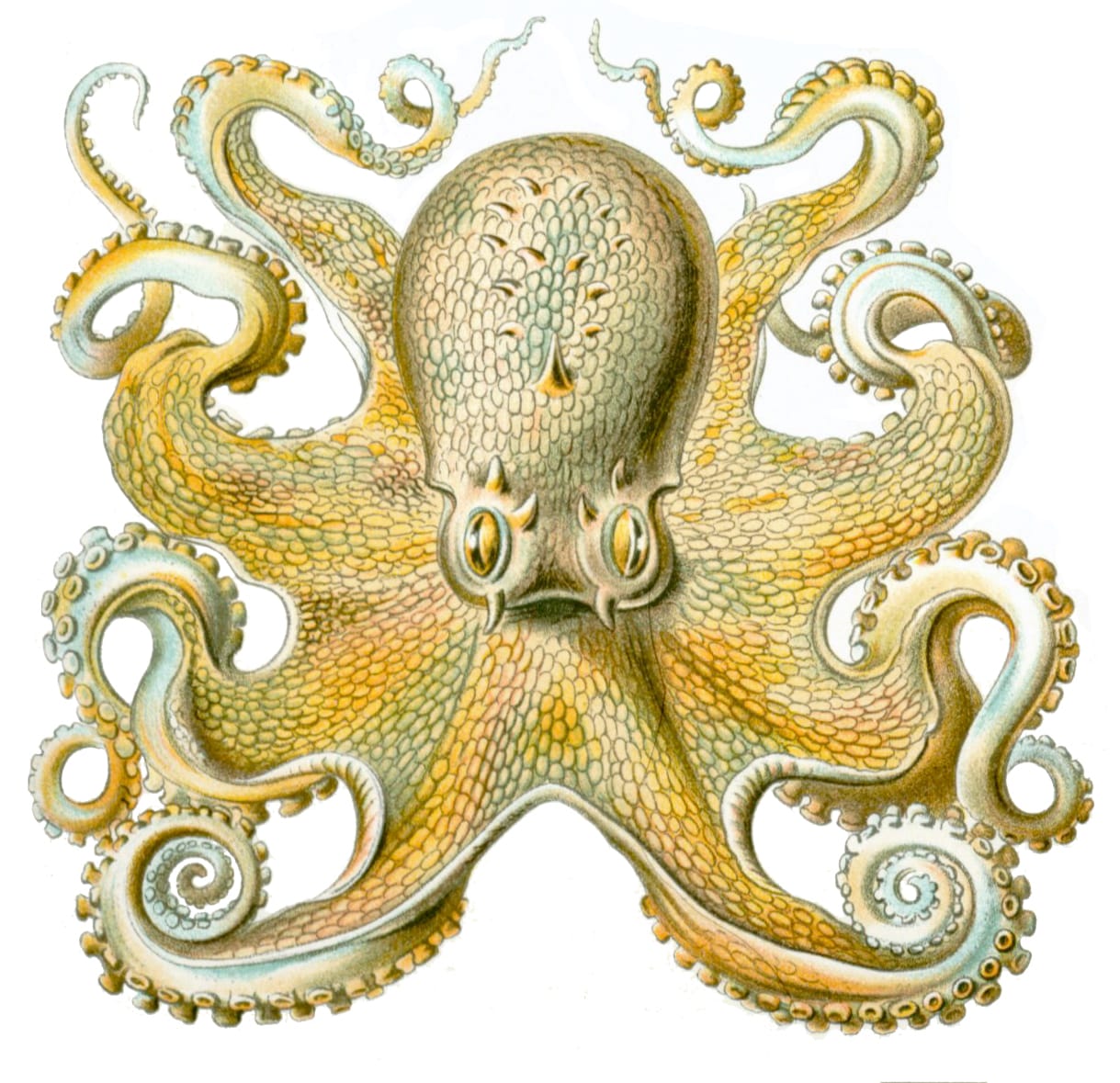
Photograph courtesy of Ernst Haeckel, Public domain
Birds do this with a different anatomy, a pallium rather than a human-like neocortex. Function can travel on more than one structure, which is part of why the Cambridge statement named birds beside mammals.
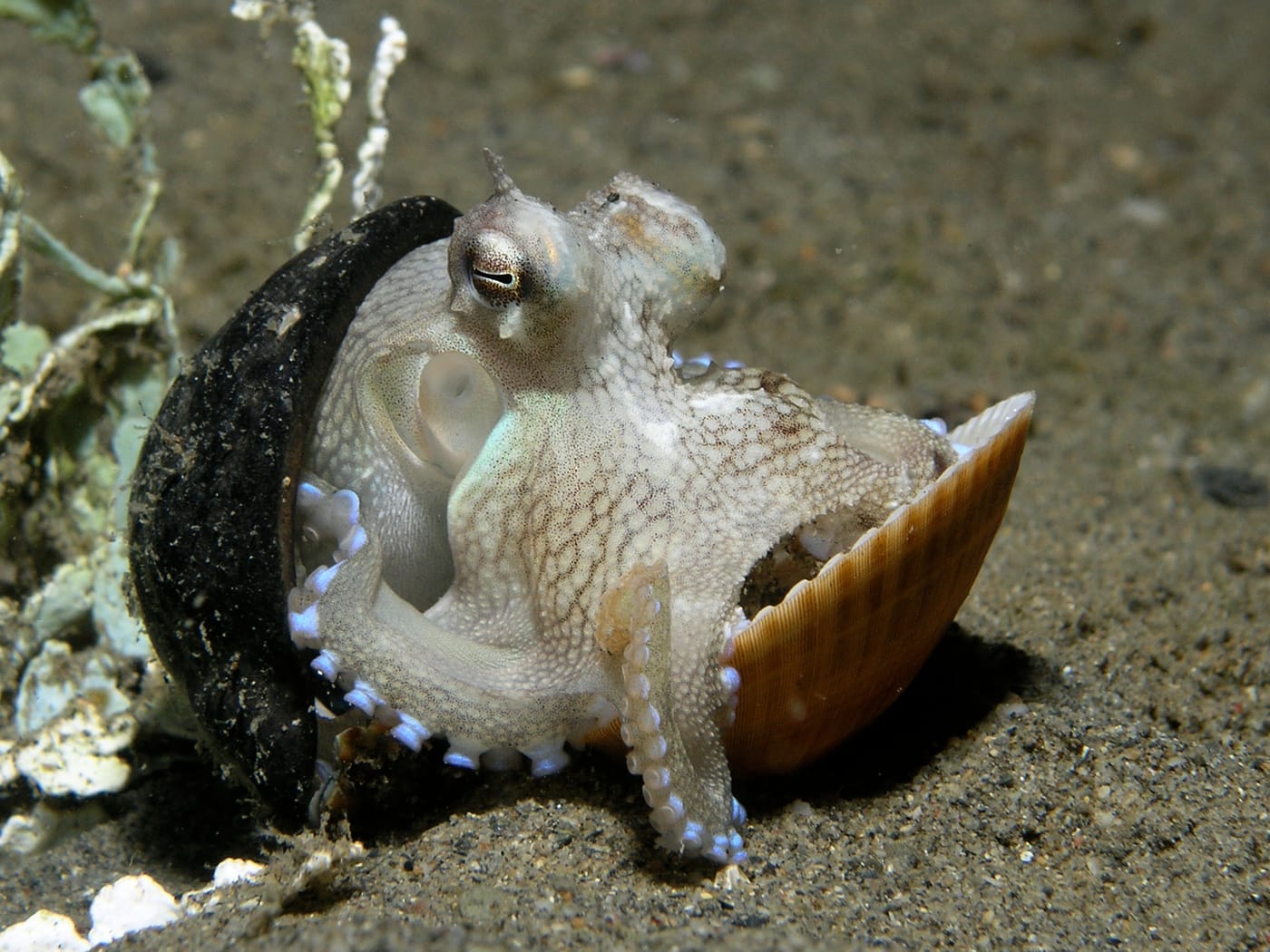
Octopuses sit outside that lineage and still force the question. They have large, distributed nervous systems. They solve problems, they play, and they show individual difference. Many researchers now treat them as conscious on that combined evidence, while still treating the conclusion as an inference.
Fish and insects are where you should slow down. Nociception, the detection of harmful stimuli, is documented in fish. Whether that detection is felt as pain, in the way you mean pain, is the consciousness question again. Stay with the evidence you have.
Can an animal know that it knows?
Self-awareness, in this literature, is the extra step: the animal can take its own body, or aspects of its own knowledge, as an object of attention.
Gordon Gallup Jr. introduced the mirror mark test in 1970. An animal is marked on a place it can see only with a mirror. If it then touches the mark on its own body, researchers treat that as evidence of mirror self-recognition (Gallup, G. G. Jr. (1970). Chimpanzees: self-recognition. Science, 167(3914), 86-87). Chimpanzees were the first reported. Later work has reported similar patterns in some other great apes, and in some studies of dolphins, elephants, and magpies.
Treat a pass as a clue. Many animals live through scent, sound, and social signal more than through vision, so a miss on a mirror does not empty the inner life. The mirror is a human-shaped door.
A second line of work asks about metacognition: does the animal behave as if it knows when it does not know? In some studies, primates and dolphins can decline a difficult memory trial, a pattern researchers interpret as monitoring of uncertainty. Take that as a pattern in behavior.
You already know the feeling from the inside. You search for a name, you notice the search, you wait. That noticing is awareness of awareness. The science is trying to find outer signs of something you only ever fully have as yourself.
Why can't you prove another mind from the outside?
You cannot. That is the honest center of the problem of other minds, and of what David Chalmers called the hard problem in the mid-1990s: why physical processes should be accompanied by experience at all (Chalmers, D. J. (1995). Facing up to the problem of consciousness. Journal of Consciousness Studies, 2(3), 200-219). In humans, researchers lean on report. You say what you feel. An animal does not hand you that sentence.
Photograph courtesy of Nick Hobgood, CC BY-SA 3.0
So the field infers from brains and from behavior. Disciplined inference still cannot become your own ache in another body.
Hold both without turning them into a fight. For many scientists the case is strong enough to change how we treat other animals, and it still never matches the certainty you have when you burn your hand.
How do you live with other minds this week?
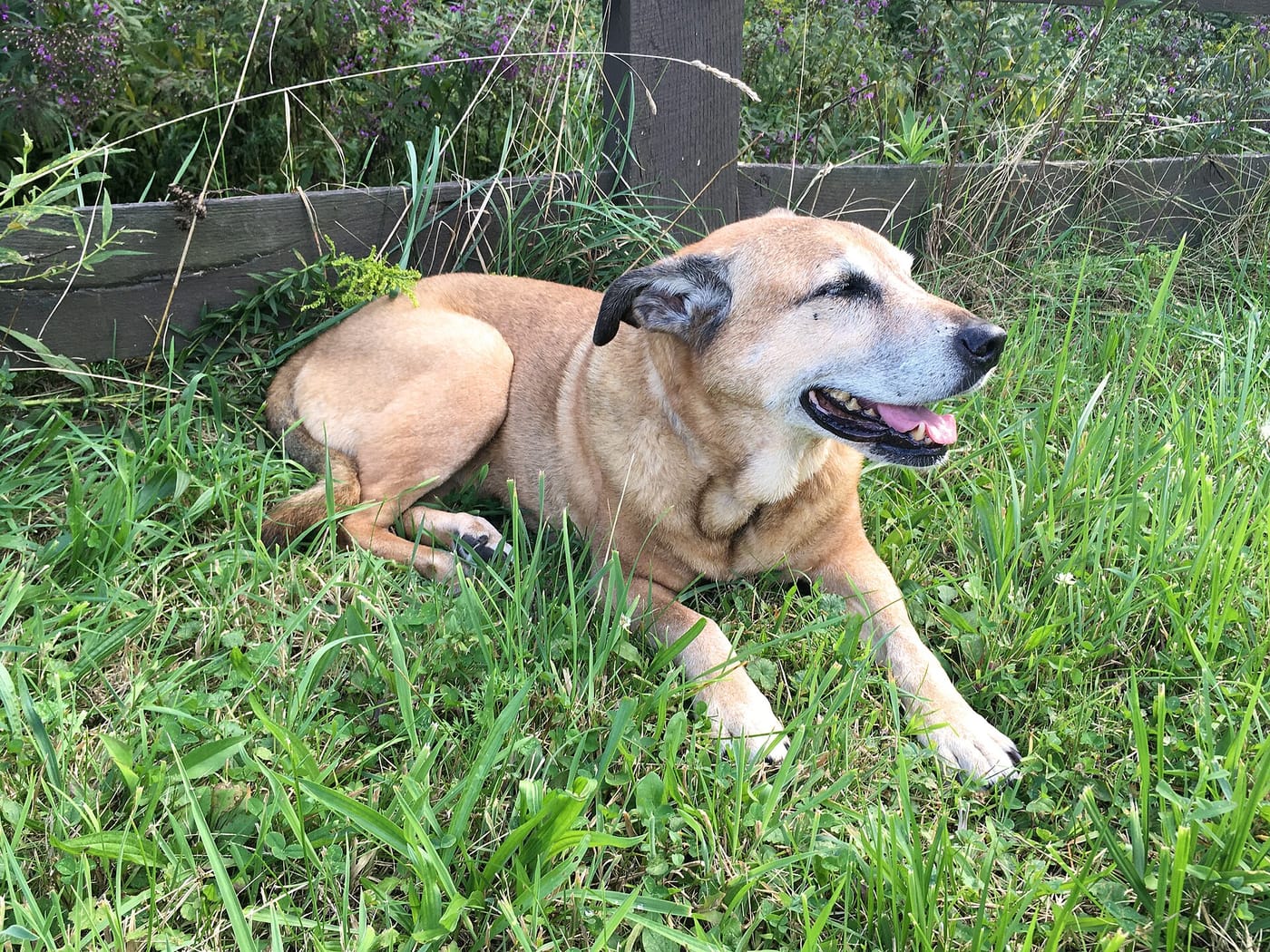
Pick one animal you already live near. The dog on the rug. The crow on the wire outside your window. The fish in the tank you pass at the store.
Photograph courtesy of Kaldari, CC0
For seven days, watch as if there might be someone home. Notice where attention goes, what is chosen, how startle settles. Do not write a novel about their soul. Look.
If you want the inner analog, sit with one of the Guided meditations and feel the difference between seeing and knowing that you see. That gap is the same gap this whole question lives in.
Then let the watching change one small act of care. Food, space, quiet, a hand that does not grab. Consciousness science will not tell you the metaphysics of a soul, and it can still tell you that you are probably not alone in having an inside.
This piece is for reflection, not medical, legal, or psychological advice, and not a prediction of any animal’s inner life.
Sources
Numerologist and Master Teacher
Brian Wroblewski is the founder of The Healer's Code. He reads charts with the Pythagorean system and teaches people how to understand the numbers they were born with.